
Can Neural Networks Think Longer to Solve Harder Problems?
Published:
Published at AAAI 2026 · Paper · Code · Talk video · Slides · Poster · maze-dataset package
TL;DR: Some neural networks can “think longer” at test time by iterating more. I stress-tested whether that extra compute lets them solve problems harder than anything they saw in training. It does — but only along certain axes: the models quietly learned a shortcut heuristic instead of a general algorithm, and diversifying the training data fixed some failures while creating others.
The problem
Production models constantly face inputs harder than their training data. Recurrent networks (RNNs) and implicit networks (INNs) offer a tempting fix: their depth is adjustable at test time, so they can spend more compute on harder inputs — like a person thinking longer about a harder puzzle. I investigated when this actually works and how it fails.
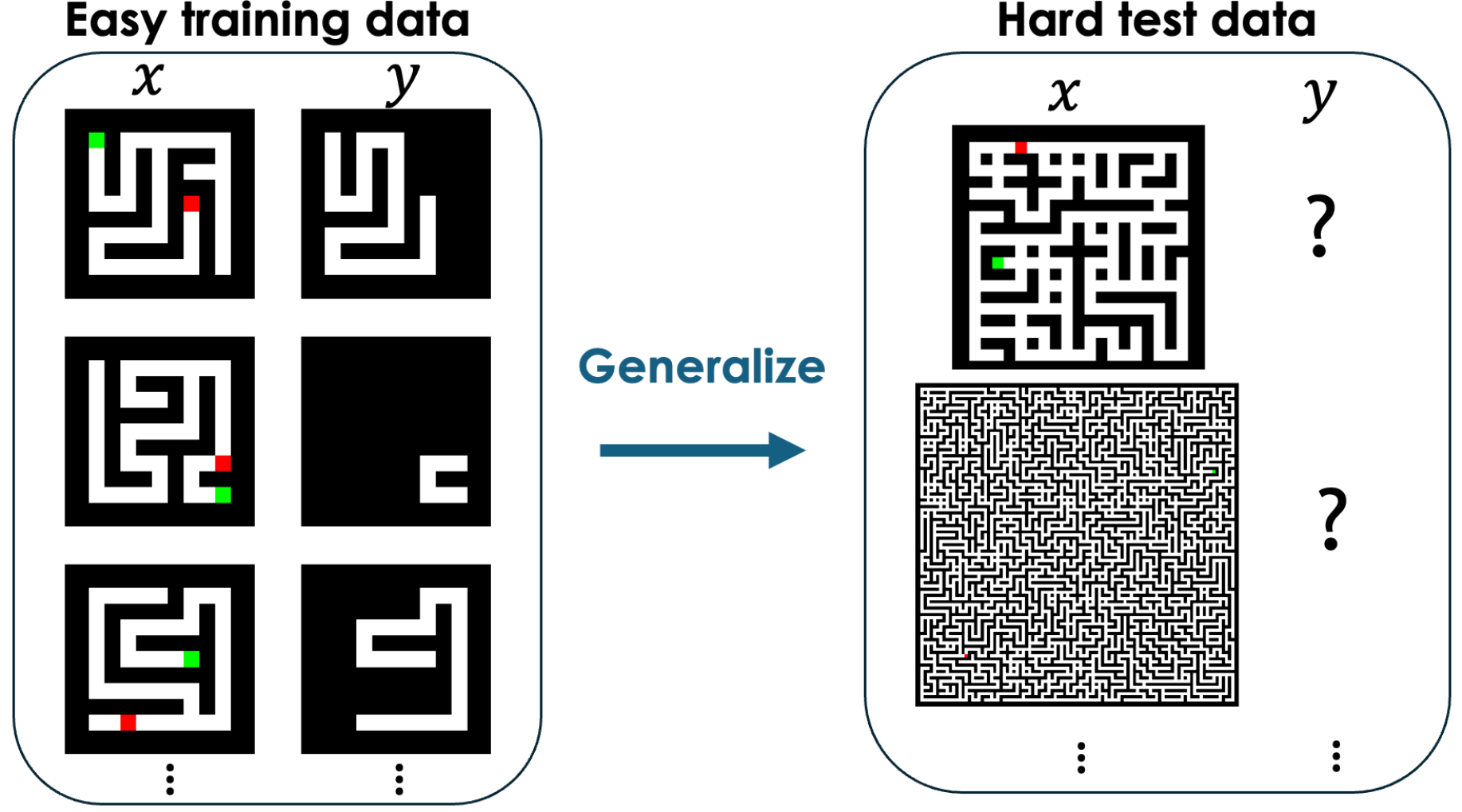
Maze-solving is the ideal testbed: classical algorithms provide ground-truth solutions at any difficulty, so I could train on small, easy mazes (9×9, no loops) and generate unlimited harder test mazes along controlled dimensions — bigger grids, “percolated” mazes containing loops, and shifted start positions.
What I did
- Evaluated a pre-trained RNN and a custom-trained INN (PyTorch) across thousands of out-of-distribution mazes, sweeping test difficulty along size and percolation simultaneously.
- Compared predictions against classical maze algorithms to identify what the models actually learned, not just their accuracy.
- Used topological data analysis (Betti numbers via persistent homology) to rigorously characterize what the models’ iterates converge to.
- Retrained both architectures across a range of training-data diversity levels, against a 10×-larger feedforward baseline.
What I found
1. Test-time compute works — dramatically. With enough iterations, the RNN solves mazes 10× larger than anything in training at near-perfect accuracy, and both iterative models beat the feedforward baseline with 10× more parameters.
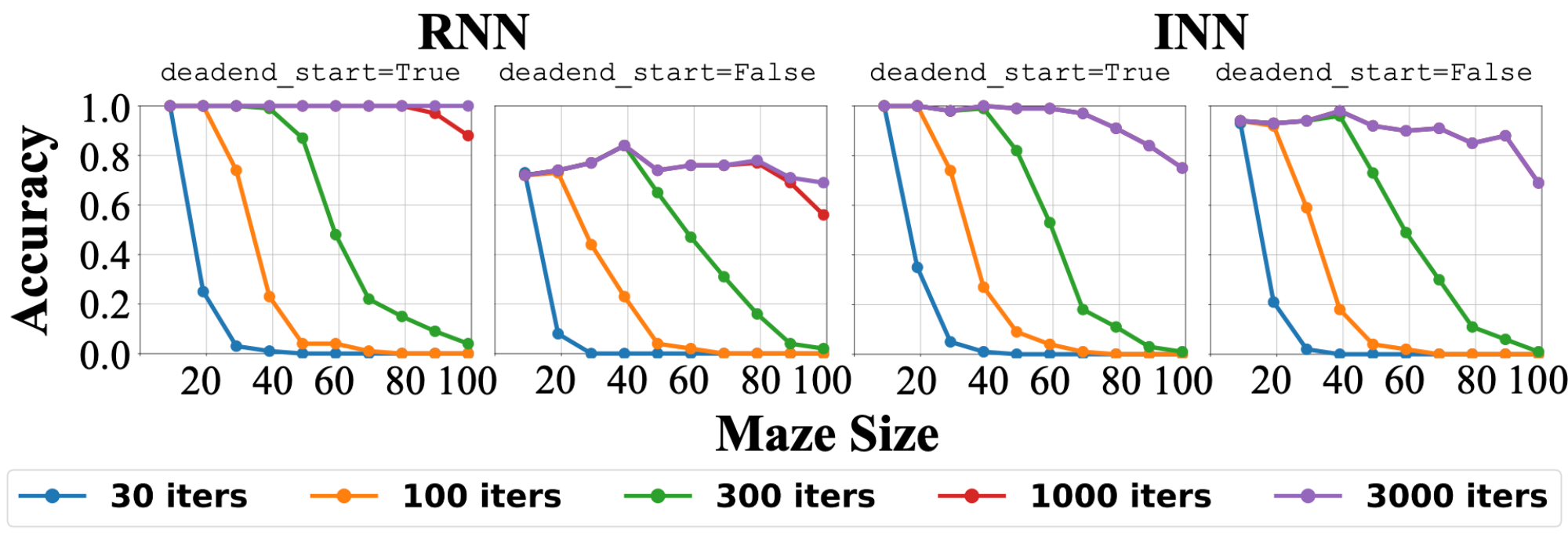
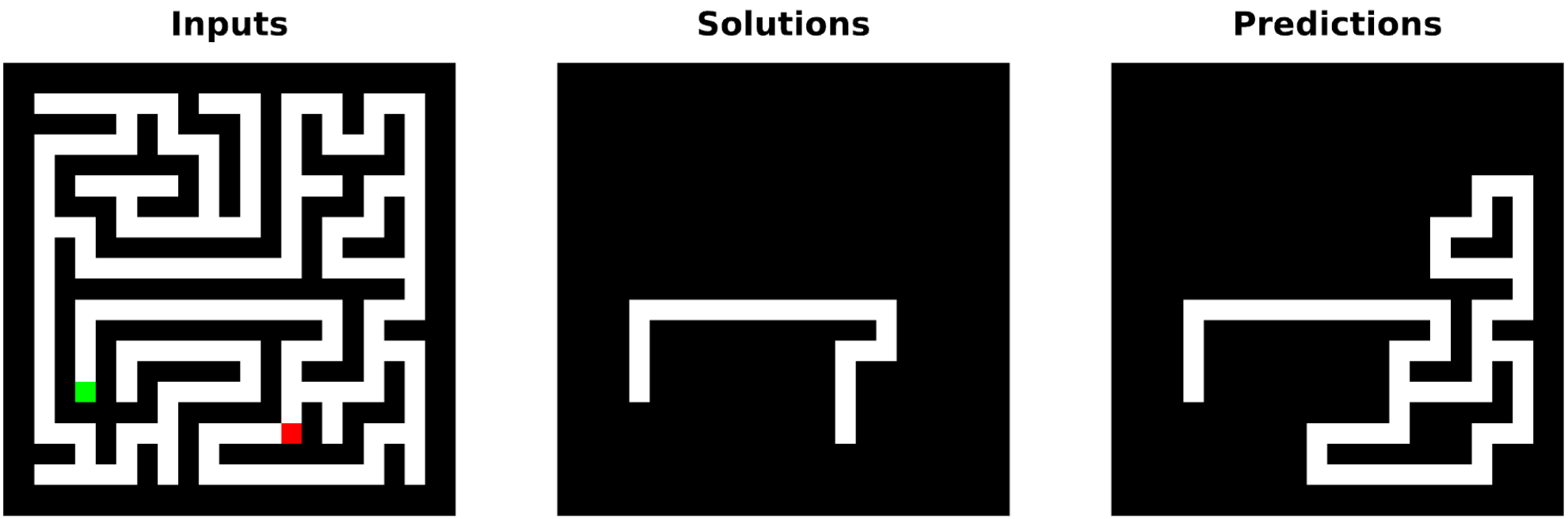
2. But the model learned a heuristic, not the goal. The RNN’s predictions match dead-end filling, a classic algorithm that provably fails on mazes with loops — and indeed the RNN collapses on them. This is goal misgeneralization: perfect training accuracy concealed that the model never learned to “solve mazes,” only a shortcut that happened to work on loop-free training data.
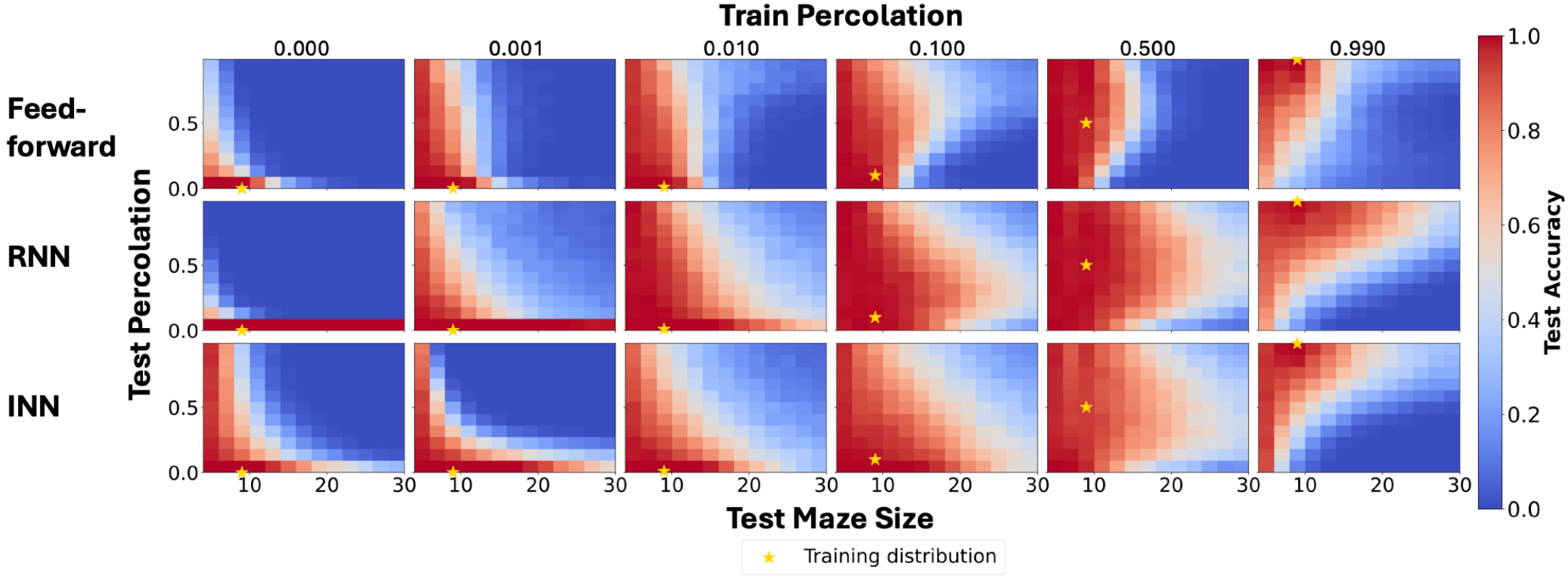
3. Data diversity is a trade-off, not a free lunch. Adding just 0.3% wall-removal to training mazes unlocked loop-solving. But as diversity increases, accuracy concentrates around the training distribution and size extrapolation degrades — a concrete, quantified case of a data-curation trade-off.
4. A standing theoretical assumption didn’t survive contact with data. Prior work assumed iterates must converge to a fixed point for extrapolation. Topological analysis revealed the RNN often converges to cycles instead — while still achieving perfect accuracy.
Why it matters beyond mazes
Every finding is a production-ML lesson in miniature: in-distribution accuracy can hide the fact that a model learned the wrong thing; evaluation must probe multiple axes of distribution shift; and “add more diverse data” reallocates capability rather than uniformly adding it. The evaluation framework — controlled difficulty dimensions with algorithmic ground truth — is the same discipline behind any serious model-validation pipeline.
Skills: PyTorch, large-scale experiment design, OOD evaluation, model debugging & failure analysis, topological data analysis, scientific communication (peer-reviewed AAAI paper + conference talk).